
In the fast-moving landscape of 2026, the way we search for homes has fundamentally shifted. We’ve moved past the era of scrolling through endless blue links. Today, the “search” happens in a conversation. We are in the real estate GEO (Generative Engine Optimization).
The Post-Keyword Era: The Real Estate GEO
Imagine a user prompting Gemini: “Find me a 2-bedroom apartment in downtown Seattle with a home office layout and south-facing windows under $3,500.”
In a split second, the AI scans millions of data points to provide a synthesized recommendation. It doesn’t just show a list; it explains why a specific unit fits the user’s life.
The Reality Check: If your listing is built on a foundation of “charming” adjectives and “vibrant” neighborhood descriptions, you simply won’t show up. AI models don’t care about marketing fluff; they care about verified parameters. Traditional SEO is evolving into GEO (Generative Engine Optimization). To rank, you must stop writing for humans who skim and start formatting for LLMs that synthesize.
Why Your Listings are “Invisible” to AI
The biggest threat to real estate marketing in 2026 is Thin Content. In the old days, a few high-res photos and a paragraph of text were enough to get indexed. Now, AI assistants prioritize High Information Density.
LLMs are inherently risk-averse. If an AI cannot programmatically verify that your apartment has south-facing windows, it won’t risk recommending it. Without granular, structured data, you hit the “Recommendation Barrier.”
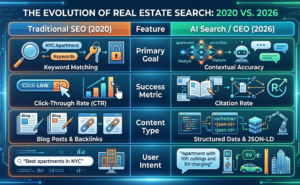
The Evolution of Search: 2020 vs. 2026
| Feature | Traditional SEO (2020) | AI Search / GEO (2026) |
| Primary Goal | Keyword Matching | Contextual Accuracy |
| Success Metric | Click-Through Rate (CTR) | Citation Rate |
| Content Type | Blog Posts & Backlinks | Structured Data & JSON-LD |
| User Intent | “Best apartments in NYC” | “Apartment with 10ft ceilings and EV charging” |
How LLMs Evaluate Authority
To understand how to rank, you have to understand RAG (Retrieval-Augmented Generation). When a user asks a question, the AI “retrieves” the most certain data it can find and “augments” its answer with that information.
AI models prioritize sources that offer unique, structured facts over recycled marketing copy. This triggers the Authority Loop.
Three Fronts of AI Dominance
Winning the GEO game requires a triple-threat approach. You must optimize your data at the source, the portal, and your private domain.
1. The MLS: Your “Source of Truth”
MLS systems (Matrix, Paragon, etc.) are the primary data feed for AI search engines. If the data isn’t here, it effectively doesn’t exist for the AI.
- Field Optimization: Fill every “optional” field. If there’s a toggle for “Bonus Room” or “Office,” use it. AI scrapers prioritize these Structured Fields over the general remarks section.
- The “AI-Ready” Remark Template: Stop writing fluff. Use high-density, conversational formats:
- Old Way: “Charming kitchen with great light.”
- 2026 Way: “South-facing kitchen with floor-to-ceiling windows (8ft). Features 2026 Bosch Series 8 appliances and a 48sq ft marble island. Dedicated 12×10 home office layout with fiber-optic wiring.”
- Media Labeling: AI “sees” via metadata.
- Bad Name: IMG_001.jpg
- Good Name: primary-bedroom-south-facing-window-view.jpg
2. The Portal Layer: Optimizing for Third-Party Marketplaces
Once your data syndicates from the primary source to major consumer platforms, you must use portal-specific enhancement tools to re-inject the depth that standard feeds often strip out. In the age of AI search, these platforms act as secondary filters that can either amplify or obscure your listing.
- Rich Media & Spatial Mapping: AI search engines on major marketplaces prioritize listings that utilize integrated 3D walkthroughs and interactive layouts. Unlike static images, these tools provide a spatial map that AI agents can “parse” to understand the flow and volume of a property, moving beyond what a flat document can convey.
- Machine-Readable Blueprints: Whenever a platform allows for the upload of vector-based or CAD-ready files, take advantage of it. Providing the AI with a direct “blueprint” of dimensions and structural data allows it to answer complex, high-intent spatial queries (e.g., “Will a king-sized bed fit in the secondary bedroom with room for a desk?”) with absolute certainty.
- Conversational Data Injection: Most modern portals now use LLMs to generate automated listing summaries. To influence these summaries, your descriptions must provide direct, factual answers to common lifestyle questions. Instead of generic praise, focus on high-density data points regarding utility, accessibility, and environmental factors that the AI can easily extract and cite.
3. Your Website: The “Citation Capture”
Portals often “sanitize” data to keep users on their site. To gain true AI Citation Authority, your own website must host the most data-rich version of the listing.
- Implement JSON-LD: This is the native language of LLMs. By embedding a FloorPlan schema, you tell the AI exactly what is inside the walls.
- The GEO FAQ Strategy: Add a “Property Specs FAQ” using FAQPage Schema. Answer the hyper-specific questions AI asks: “What is the exact ceiling height?” or “What direction do the windows face?”
The “Schema” Edge
The floor plan is your secret weapon. In 2026, it must be a data object, not just a JPEG.
Pro Tip: By explicitly labeling a room as roomType: “Home Office”, you win the query for “remote-work friendly rentals.” Your competitors, who simply wrote about “extra space” in a paragraph of text, will be ignored by the AI because “extra space” is too ambiguous to verify.

Becoming the Source of Truth
The shift from SEO to GEO isn’t just a technical update; it’s a mindset shift. The goal in 2026 isn’t just to get a click; it’s to be the cited authority that the AI trusts enough to recommend to a high-intent lead.
Final Thought: In 2026, the best “copywriter” on your team is the one who understands your Data Schema. Be the source of truth, and the AI will reward you with the close.