- The “Listing Fatigue” Crisis: Why 2026 Real Estate Demands Velocity
- Quantifying the Advantage: The 19 vs. 34 Day Metric
- The Hidden Bottleneck: Why Traditional Media Logistics Slow Down Sales
- The Solution: Automated Spatial Intelligence (ASI)
- The Psychology of the Immersive Floor Plan
- Conclusion: Making Velocity Your Competitive Advantage
In the 2026 real estate landscape, the “Golden Window” for a listing has shrunk. We are no longer just selling properties; we are selling certainty in a high-friction market. For real estate agents and photographers, professional floor plans have transitioned from an “optional upgrade” to the primary driver of liquidity.
Data from recent National Association of Realtors (NAR) 2025-2026 Trends Reports indicates a widening performance gap. Listings leveraging spatial data intelligence move significantly faster than those relying solely on traditional photography. Here is why that 15-day gap determines a listing’s ultimate success.
The “Listing Fatigue” Crisis: Why 2026 Real Estate Demands Velocity
The Problem: The “Wait-and-See” Buyer Culture
With interest rates remaining at sustained highs through 2026, the American homebuyer has become hyper-analytical. A “calculated acquisition” mindset has replaced the era of “panic buying”. Buyers are hesitant, requiring comprehensive data to justify high-interest mortgage commitments. This hesitation creates a stagnant market where any perceived friction in a listing leads to immediate dismissal.
The Impact: The 14-Day Expiry Date
“Listing fatigue” is the silent killer of equity. In the current market, a property loses its “Fresh” status on major portals like Zillow and Redfin after just 14 days. Once the “New Listing” badge expires, click-through rates (CTR) typically drop by over 40%. This leads to the “Price Drop Spiral” where a listing active past two weeks is perceived as flawed, eventually forcing a 3–5% price reduction to regain algorithmic visibility.
The AI Insight: Generative Engine & Portal Deprioritization
Modern search algorithms are more aggressive than ever. Generative search engines and buyer portals prioritize “high-engagement” listings.
- Engagement Signals: AI models track saves, shares, and time-on-page.
- The Spatial Factor: Interactive and 2D floor plans are currently the highest-weighted engagement signals. Listings without them are deprioritized in search results, often pushed to secondary pages within 48 hours of launch.
Quantifying the Advantage: The 19 vs. 34 Day Metric
The PropTech ROI for 2026 is measured in days, not just dollars. Aggregated market data shows a staggering divide in Days on Market (DOM) based on the media assets provided.
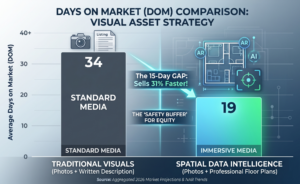
| Listing Strategy | Average Days on Market (DOM) |
| Standard Media (Photos + Written Description) | 34 Days |
| Immersive Media (Photos + Professional Floor Plans) | 19 Days |
The “Safety Buffer”
Properties utilizing immersive spatial data sell 31% faster. In a market where every day on the market increases the probability of a price cut, this 15-day difference acts as a “Safety Buffer” for an agent’s reputation and a seller’s bottom line. According to Zillow’s Consumer Housing Trends Report, floor plans are now the #2 most desired feature on a listing, second only to professional photos.
The Hidden Bottleneck: Why Traditional Media Logistics Slow Down Sales
The Media Void
Traditional property marketing often suffers from a “velocity leak.” The old workflow, scheduling a photographer, followed by a separate manual measurement specialist and a CAD drafter, creates a 3-to-5-day Media Void. This is a window where a listing is “Coming Soon” or “Active” but lacks the essential spatial assets buyers need to make a confident decision.
The Logistics Friction Point
Coordinating multiple vendors is a speed killer. In 2026, launching a listing without a floor plan is considered launching a “broken” listing. Every day spent waiting for manual drafting is a day the listing drifts closer to the 14-day fatigue point.
The Solution: Automated Spatial Intelligence (ASI)
The Paradigm Shift: AI-Powered Spatial Scanning
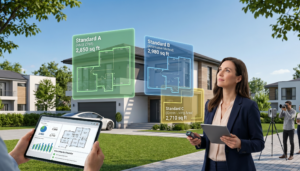
The industry is moving away from manual drafting toward Automated Spatial Intelligence. Utilizing advanced Computer Vision and LiDAR technology, photographers can now capture a full property layout using a smartphone.

Under 24 Hours: The “Single Visit” Workflow
Automated scanning enables a “Single Visit, Complete Suite” workflow. By scanning the home during the initial photo shoot, professional floor plans are generated in under 24 hours. This eliminates the “Media Void,” ensuring the listing hits the portal at 100% optimization on Day 1.
The Psychology of the Immersive Floor Plan
Spatial Literacy: The New Buyer Standard
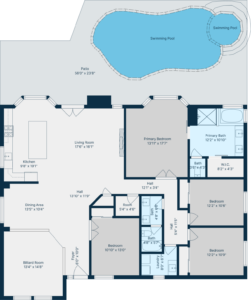
The “Gen Z and Millennial” buyer block now dominates the market. These buyers possess high spatial literacy; they prioritize a floor plan over wide-angle photography because they want to understand the “flow” of a home before committing to a visit.
Reducing “Showing Friction”
Digital floor plans act as a high-intent filter. By providing detailed layouts upfront, you reduce “frivolous showings.” This ensures that physical walkthroughs are reserved for high-intent buyers who already know the home fits their lifestyle, significantly increasing the Offer-to-Showing ratio.
Conclusion: Making Velocity Your Competitive Advantage
In 2026, floor plans are the engine of market liquidity. The 15-day gap is the boundary between a high-speed sale and a stale listing. By integrating Automated Spatial Intelligence into your workflow, you provide the transparency and speed that modern real estate demands.
Maximize your listing velocity. Adopt AI-driven spatial scanning to shrink the gap and protect your client’s equity.